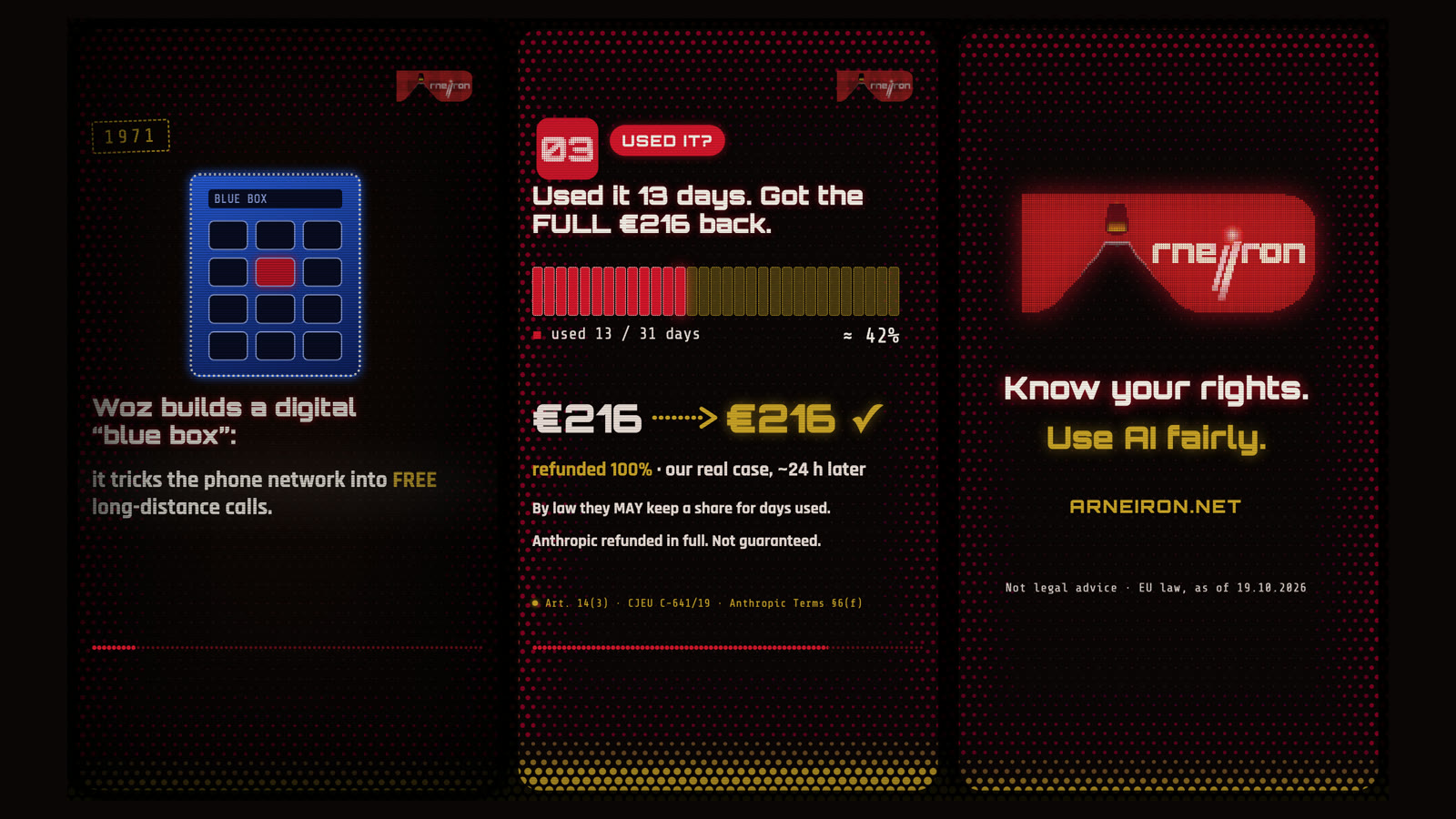
In 1971 two young men in California sold an illegal gadget that made long-distance calls free. In 2026 nobody needs a gadget: if you live in the EU and have just bought a subscription, an AI plan for example, the law gives you 14 days to change your mind. We tested it on a Claude Max plan. Here is what the right covers, how to use it properly, and where it stops.
1. 1971: the blue box, and why it was illegal
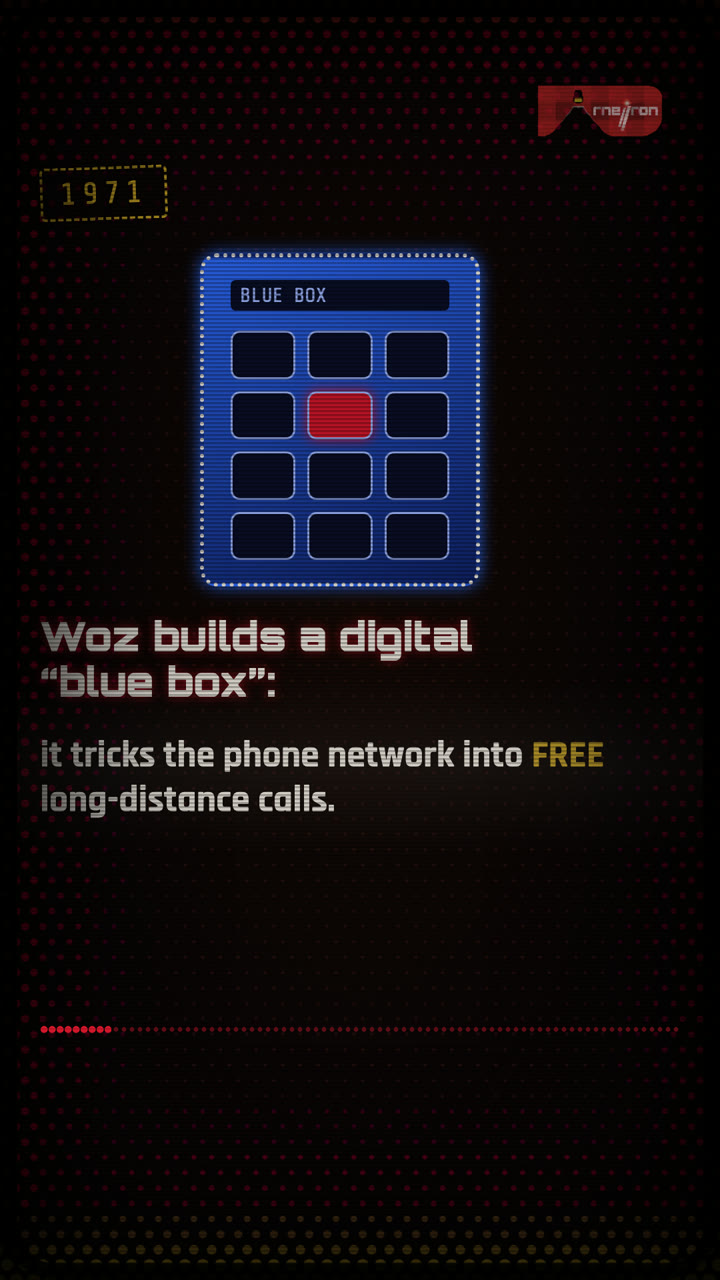
In October 1971 Esquire published Ron Rosenbaum’s “Secrets of the Little Blue Box”, a report on the “phone phreaks” who used tones to take over the long-distance telephone network. Two readers, Steve Wozniak and Steve Jobs, decided to build one. Wozniak designed a digital version. For a test call he rang the Vatican posing as Henry Kissinger and asked for the Pope, who was asleep. Jobs sold the boxes for about $150 each. In a 1994 interview, quoted in Walter Isaacson’s 2011 biography, Jobs said: “If it hadn’t been for the Blue Boxes, there would have been no Apple.”
It was also fraud against the phone company. Phreaking was illegal then and it is illegal now, and this article contains no instructions. We tell the story for the contrast: what the two Steves got by tricking a system, EU consumers can partly get lawfully, because the law says so.
2. 2026: the EU right of withdrawal for new subscribers
The Consumer Rights Directive 2011/83/EU gives consumers who buy online 14 days to withdraw from a contract without giving any reason (Article 9). For a service the period starts on the day the contract is concluded. Since the Omnibus Directive (EU) 2019/2161, online digital services such as cloud software and AI subscriptions count as services for this rule, so a new monthly AI plan bought in the EU is covered.
There are limits. The right protects consumers, not businesses, and it belongs to a new contract: it is not a monthly refund button. A service that has been fully performed with your express consent loses the right (Article 16(a)), but a monthly plan is not fully performed on day 13. If the provider picks another country’s law, as Anthropic’s terms pick Irish law, Article 6 of the Rome I Regulation keeps the mandatory protection of the country where you live.
3. How to withdraw properly: cancel is not withdrawal
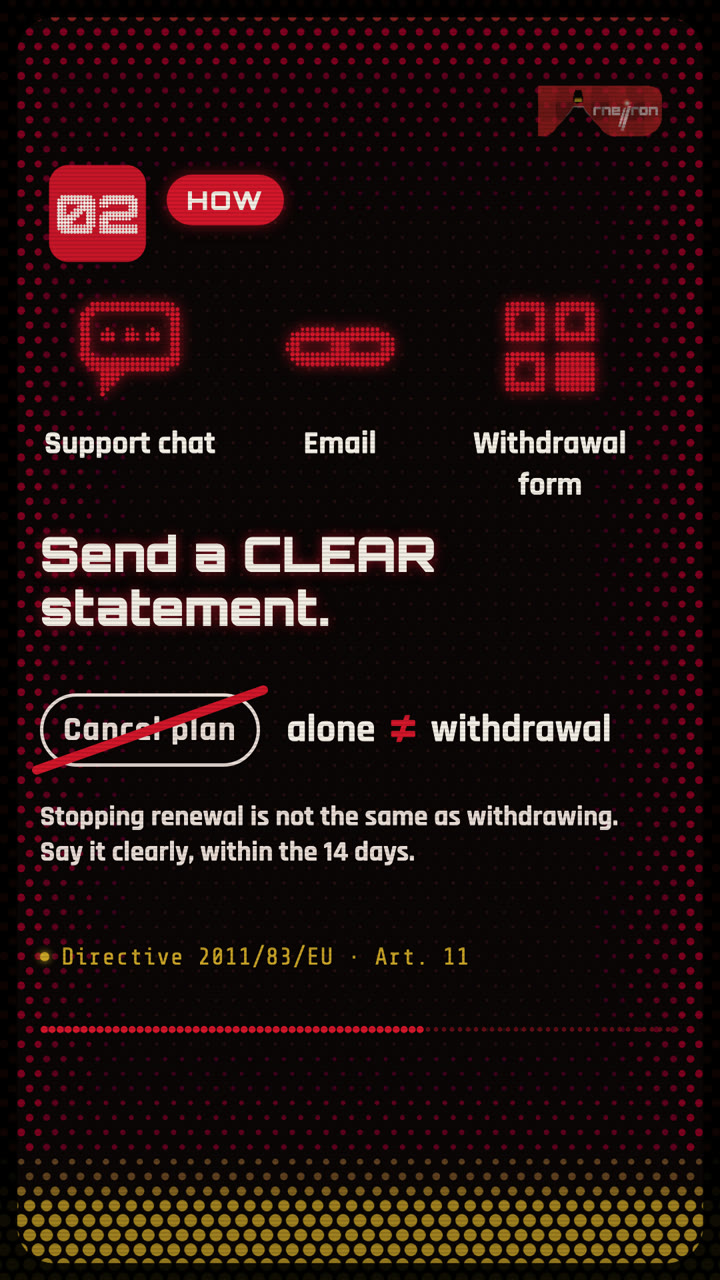
Article 11 asks for a clear statement that you are withdrawing from the contract. You may use the model withdrawal form, but you don’t have to. A support-chat message or an email works, as long as the meaning is clear and you send it within the 14 days. Sending it in time is enough. Keep a copy or a screenshot.
The cancel button is something else. In most apps it only stops the next renewal and you keep access until the paid month ends. That is not a withdrawal and does not trigger a refund. Write something like: “I withdraw from my contract for the [plan], concluded on [date], under my 14-day right of withdrawal.” In Austria the same rules are in the FAGG, sections 11 to 18.
4. Our test: day 13, the full €216 back about 24 hours later
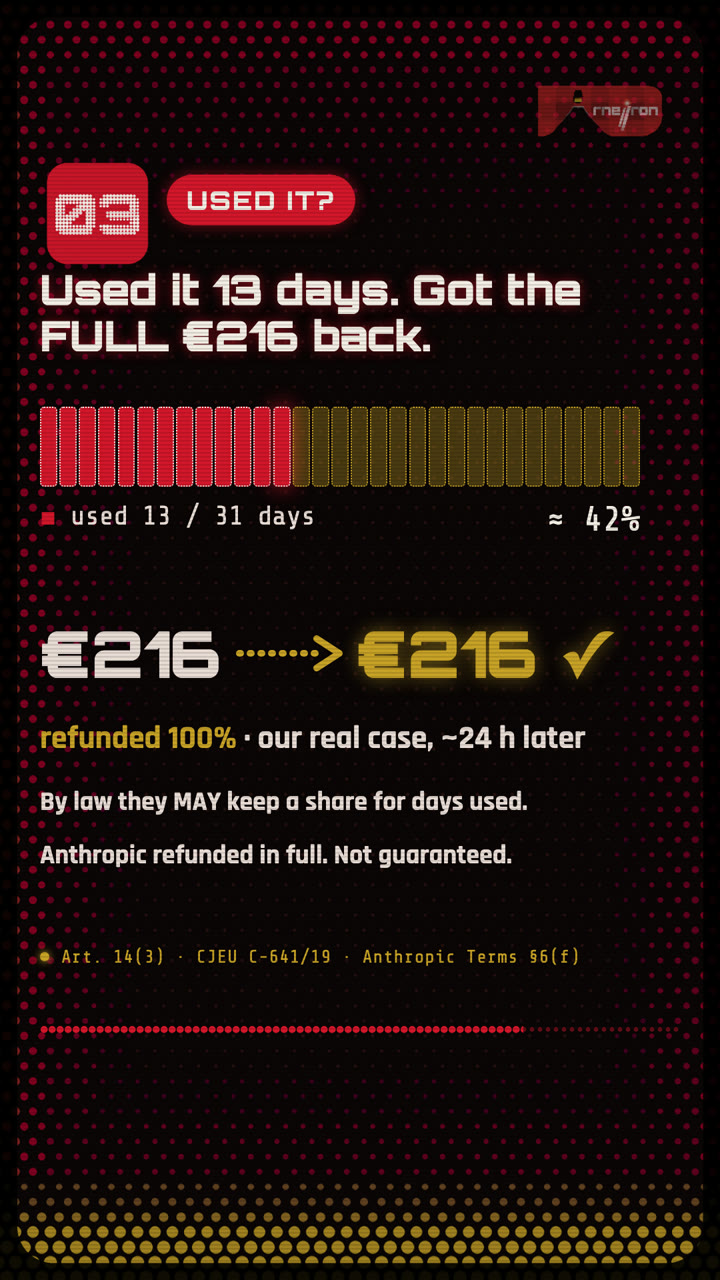
We subscribed to Claude Max for €216 (VAT included) on 1 October 2026, used it for 13 days and withdrew on 14 October, day 13 of the period. The next day Anthropic issued a credit note for the full €216, refunded to the card we had paid with, about 24 hours after the withdrawal. Nothing was deducted for the 13 days of use.
That is the headline result, and it is a real case. It is also one case. It shows what one provider chose to do, not what every provider must do: Anthropic’s own consumer terms (section 6(f)) allow it to keep a proportionate amount, and so does the law.
5. The law still allows a proportionate deduction
If you asked for the service to start during the withdrawal period and the provider informed you properly, you owe a proportionate amount for what you received up to the withdrawal (Article 14(3)). The Court of Justice of the EU held in case C-641/19 (PE Digital) that this is normally calculated by time, pro rata.
Worked example for our case: €216 for a 31-day month, 13 days used. 13/31 × €216 = €90.58 the provider could keep, so €125.42 would come back. The provider may waive the deduction, as Anthropic did here. If the provider never gave you the withdrawal information, or you never expressly asked for an early start, you owe nothing (Article 14(4)).
6. The refund: within 14 days, same payment method
Once the provider receives your withdrawal, it has 14 days to pay back what you are owed (Article 13(1)). It must use the same means of payment you used, unless you expressly agree to something else and it costs you nothing. Our refund came after one day. Fourteen days is the legal maximum, and your bank may need a few more days to show the credit.
7. No reset when you resubscribe: don’t game it
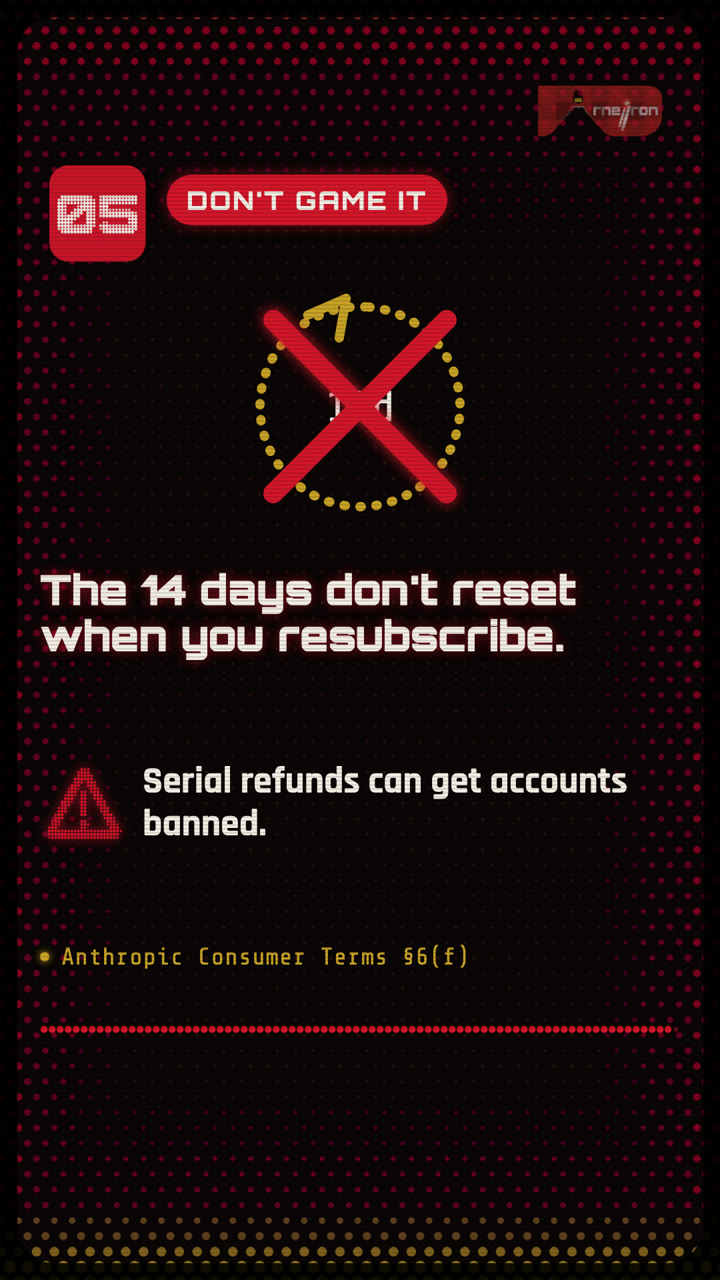
The right exists so you can try a purchase and change your mind. Anthropic’s terms say the 14-day period “will not reset if you change subscription tiers or cancel and then resubscribe”. In C-565/22 (Sofatutor) the CJEU decided that a free trial which turns into a paid plan gives one withdrawal right if the price was clearly shown at the start, not a new right every cycle.
Subscribing, withdrawing and starting again, perhaps with a new account, to get a service for free is not what the law protects. Providers can claim the proportionate amount, refuse on abuse-of-rights grounds, close accounts and block cards. Use the right honestly: if a plan doesn’t fit, say so clearly and in time.
Sources
- Directive 2011/83/EU (Consumer Rights Directive), Art. 9, 11, 13, 14(3), 16
- Directive (EU) 2019/2161 (Omnibus Directive)
- Austria: FAGG §§ 11–18
- CJEU C-641/19 PE Digital (8 Oct 2020)
- CJEU C-565/22 Sofatutor (5 Oct 2023)
- Rome I Regulation (EC) 593/2008, Art. 6
- Anthropic Consumer Terms, § 6(f)
- Ron Rosenbaum, “Secrets of the Little Blue Box”, Esquire, October 1971
- Walter Isaacson, Steve Jobs, Simon & Schuster, 2011
General information on EU consumer law as of 19 October 2026, not legal advice. Your own case depends on the provider’s terms, what you were told at checkout and the law of your country.
Leave a Reply