
Five stories from the last 48 hours in AI and tech: a robot race up one of China’s most famous mountains, a second wave of hacks that turned up the heat in Europe’s supermarket freezers, a roughly $115 billion bet on the optics inside AI data centres, a central-bank warning about AI share prices, and Turkey’s move against Google’s AI answers. Each section says what happened, why it matters and what is still unclear.
Watch the 42-second short:
Also on Telegram: t.me/arniron/40
1. Robots race up the 3,000 steps of Mount Tai
On 2 November about 90 teams sent their robots up the stone stairway of Mount Tai in Shandong province, a UNESCO World Heritage site, in what organisers called the first CMG World Robot Mount Tai Climbing Competition. The route had more than 3,000 steps. According to CBS News and AFP, the fastest humanoid robot, from Zhishen Lingyue, finished in 27 minutes 26 seconds, and Beijing Lingyi Technology won the four-legged speed category in 43 minutes 41 seconds. Some robots carried loads; several stumbled or fell.

Why it matters: stairs, uneven stone and crowds are exactly the conditions that lab demos avoid. Reuters notes that Chinese robot makers have largely mastered movement and are now racing to give machines better ‘brains’ for real tasks. The caveat: a competition shows what a robot can do on a good day with a team nearby, not how reliably it works for months without help.
2. Hackers heat up supermarket freezers again
A second wave of suspected cyberattacks has hit supermarket refrigeration in Europe. Irish broadcaster RTÉ reports that 13 SuperValu stores in Ireland were affected by an attack on a specific model of internet-connected refrigeration equipment; The Guardian reports disruption at supermarkets in several European countries. In October, hundreds of French supermarkets saw freezer temperatures pushed to around 50 °C, spoiling food.

Why it matters: this is a reminder that ‘smart’ equipment in shops is part of the attack surface, and the damage is physical: lost stock, closed aisles, and safety risks. The caveat: nobody has claimed the attacks and no authority has named a perpetrator. It is also not yet confirmed that the Irish incident is linked to the others; one expert told RTÉ a link would most likely be the shared make of equipment.
3. Marvell to buy Lumentum in a ~$115 billion AI optics bet
Chipmaker Marvell agreed on 2 November to buy optical-component maker Lumentum in an all-stock deal that Reuters values at about $115 billion. Lumentum makes lasers and photonic parts that move data between servers in AI data centres; Marvell makes custom chips, switches and connectivity silicon. Nvidia had invested $2 billion in each company. It is Marvell’s largest purchase since it bought Inphi for $10 billion in 2021.
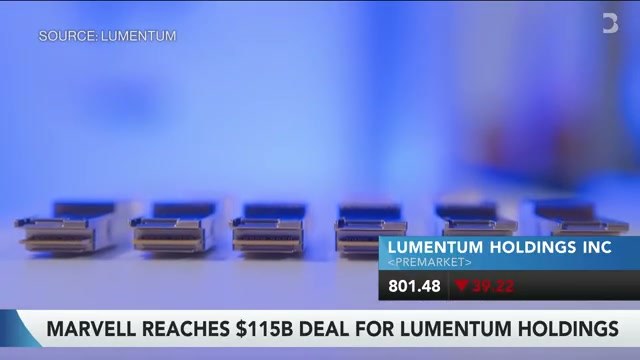
Why it matters: as AI clusters grow, the bottleneck shifts from compute to moving data between chips, and optics is where that happens. Reuters frames the deal as Marvell stepping up its challenge to Broadcom. The caveat: the deal still needs shareholder and regulatory approvals, and its price depends on share prices that have been volatile.
4. ECB warns that AI share prices look stretched
European Central Bank Vice-President Boris Vujčić named elevated AI-linked equity valuations, tensions in sovereign bond markets and possible losses at non-bank funds as the main risks to financial stability, Reuters reports. The ECB’s full Financial Stability Review is due on 18 November.
Why it matters: when a central bank says valuations are stretched, it is watching how a sharp fall could spread through funds and markets, which affects savings and loans far beyond tech. The caveat: this is a risk assessment, not a forecast that an AI crash will happen.
5. Turkey opens a probe into Google’s AI answers
Turkey’s Competition Board (Rekabet Kurulu) opened an investigation into Google’s AI Overviews and AI Mode on 2 November and imposed an interim measure, Anadolu Agency reports. Under the measure, websites must be able to stop their content being used in Google’s AI answers without losing visibility in normal search results.
Why it matters: publishers worry that AI summaries answer the question on Google’s own page and cut the traffic that pays for journalism. Turkey is one of the first competition authorities to act with a binding interim step. The caveat: an interim measure is not a final ruling; the investigation will decide whether Google actually broke competition law.
Leave a Reply